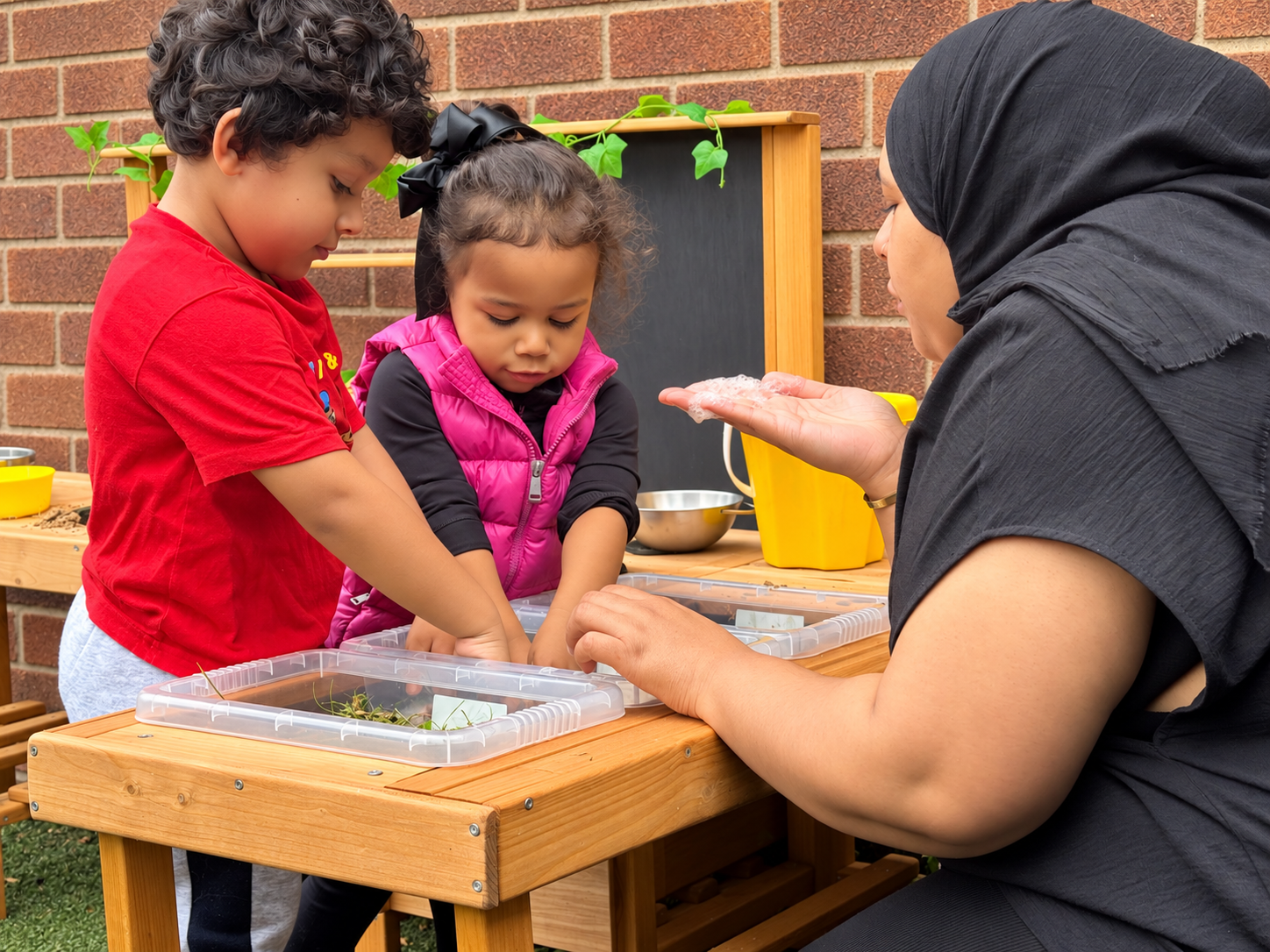
Children exploring an outdoor mud kitchen at Shooting Stars Nursery

Our Curriculum

Every Child at the Centre of The Five Planets of Learning

In Simple Terms

Our curriculum is what we want our children to learn.

It brings together the knowledge, skills, experiences and values we want every child to develop during their time at Shooting Stars.

Our pedagogy is how we help them learn it.

OUR APPROACH TO LEARNING

A Curriculum Built Around Every Child

At Shooting Stars, we believe every child is a star in their own right, full of energy, light and potential. Our role is to create the right environment for them to shine.

Children learn best when they are curious, engaged and supported to explore the world around them. Our Five Planets of Learning bring together the statutory EYFS and our nursery’s commitment to sparking curiosity in every child.

As children move through the Five Planets, they develop the skills, knowledge and confidence they need—not only for school, but for life.

Children are natural-born scientists, constantly forming ideas, testing hypotheses and learning from what they discover.

INSPIRED BY THE WORK OF ALISON GOPNIK
Our Curriculum

The Five Planets of Learning

Every child is at the centre of our curriculum. Open each planet to discover how it supports children’s learning, development and confidence.
Curiosity Planet of Curiosity Sparking wonder

Children are naturally driven to explore. They want to find out what happens when they mix, build, pour, move, take things apart and try again. On the Planet of Curiosity, we protect this desire to discover rather than rushing children towards one “right” answer.

Our practitioners notice what has captured a child’s interest and build on it with thoughtful questions, new vocabulary and carefully chosen resources. Children are given time to test their ideas, make connections and change their minds. This is how early problem-solving, creativity and scientific thinking begin.

What this might look like

  • Investigating why ice melts or how shadows change
  • Testing which materials roll, float, balance or join
  • Returning to an investigation over several days

Research behind this planet

Young children test ideas against evidence, while guided play combines their exploration with sensitive adult support.

Gopnik: Scientific thinking in young children Weisberg, Hirsh-Pasek & Golinkoff: Guided play

Communication Planet of Communication Finding their voice

Communication is about much more than spoken words. Babies and young children communicate through sounds, facial expressions, gestures, movement, play and behaviour. We take time to understand each child’s individual way of sharing their needs, feelings and ideas.

Through warm conversations, songs, stories and imaginative play, practitioners introduce new language and give children time to respond. Visuals, signs and other forms of communication are used when helpful so every child can participate, connect and be heard.

What this might look like

  • Talking together during play rather than testing children
  • Using stories, songs, Makaton, visuals and role play
  • Helping children name feelings and communicate their needs

Research behind this planet

Language and communication are central to relationships and children’s access to learning experiences.

Dockrell & Marshall: Language skills in young children Hart & Risley: Early language experiences

Belonging Planet of Belonging Feeling safe and valued

Children learn best when they feel safe, known and accepted. A strong sense of belonging begins with secure relationships, so we make time for children to build trust with familiar adults and form friendships at their own pace.

We celebrate each child’s family, culture, language and identity while helping them understand and respect others. When children know that they belong, they are more willing to explore, try something new and recover from difficulties.

What this might look like

  • A consistent key person who knows the child and family
  • Home languages, photographs and traditions reflected in nursery
  • Support with friendships, feelings and disagreements

Research behind this planet

Evidence identifies belonging as a fundamental human need, while positive early relationships support development and learning.

Baumeister & Leary: The need to belong Sylva and colleagues: The EPPE Project

Independence Planet of Independence “I can do it myself”

Independence does not mean expecting children to manage everything alone. It means giving them the right amount of support and gradually stepping back as their confidence and ability grow. Small everyday successes teach children that their choices and actions matter.

Children are encouraged to choose resources, care for their belongings, help with routines and attempt manageable challenges. When something does not work straight away, practitioners help them pause, think and try another approach.

What this might look like

  • Putting on a coat, serving food or washing their hands
  • Choosing resources and returning them afterwards
  • Trying to solve a problem before an adult steps in

Research behind this planet

Independent learning and self-regulation develop through everyday experiences and are connected with later school readiness.

Whitebread and colleagues: Independent learning Denham and colleagues: Self-regulation
Horizons Planet of Horizons Always looking ahead

Every stage of early childhood brings something new. Planet Horizons helps children approach change with confidence, whether they are settling into nursery, moving into a new room or preparing to begin school.

We prepare children gradually through familiar routines, honest conversations and close partnership with families. School readiness is not about pushing formal learning too early. It is about developing the communication, independence, curiosity, relationships and emotional security children need to thrive.

What this might look like

  • Visits before moving into a new nursery room
  • Stories and conversations about upcoming changes
  • Working with families and schools to make transitions calm

Research behind this planet

Well-planned, child-centred transitions supported by families and educators help children feel secure in their next environment.

Fabian & Dunlop: Good practice in transitions OECD: Starting Strong V

Research links open in a new tab. Some publications may require institutional access.

How Our Curriculum Works

How Learning Takes Flight

Meaningful learning does not happen by accident. Our practitioners observe, plan, support and reflect so that every experience responds to the child in front of them.

Intent

The Flight Plan

We begin with the child. Practitioners consider what they already know, what interests them and what they may be ready to explore next. Family knowledge also helps us understand the whole child.

Implementation

The Journey

The flight plan comes to life through play, conversation and the environment. Practitioners introduce ideas, model language and offer just enough support to help children think more deeply.

Impact

The Landing

We notice the difference the experience has made. This may be a new word, a stronger skill, a fresh idea or the confidence to try without help. Impact is seen in the child, not through formal testing.

Reflection

Mission Debrief

Afterwards, practitioners reflect on what worked, what the child showed us and what could happen next. We celebrate success, adapt our approach and use what we have learned to shape future experiences.

A Simple Example

Learning at the water tray

One everyday experience can support several areas of learning when it is guided by a clear purpose and responsive adults.

The Flight Plan

Support children to explore capacity, hear useful words and practise sharing resources.

The Journey

Add jugs and funnels, model words such as “full” and “empty” and invite children to predict what might happen.

The Landing

A child compares containers, uses new language or works with another child to solve a problem.

Mission Debrief

Notice what interested the children and decide whether to revisit the idea with different containers or another material.

Our Child-Centred Curriculum

Learning Is Not a Checklist

Children do not develop in straight lines, and childhood is not a series of boxes to tick. Although our curriculum is aligned with the EYFS, it adapts around each child—their interests, relationships, culture, strengths, needs and individual pace.

Rather than moving children through a fixed programme of activities, we surround them with opportunities to develop across our Five Planets. These areas are closely connected and will look different for every child.

A child may be growing in confidence and belonging while beginning to communicate in new ways. Another may be deeply curious, testing ideas and becoming increasingly independent. There is no single route and no expectation that every child will progress in the same way or at the same time.

Our practitioners observe, listen and respond. They know when to introduce a new idea, when to offer support and when to step back. Progress is understood through the child we see each day—not by comparing them with others or reducing their development to a checklist.

Belonging Curiosity Communication Independence Horizons

Every child follows a unique orbit.
Our curriculum moves with them.

Working Together

Families Are Our Co-Pilots

You know your child better than anyone. By sharing what matters at home, including their interests, routines, experiences, language and changing needs. This helps us understand the whole child and shape a curriculum that is meaningful to them.

Partnership is not limited to handovers at the nursery door. We keep communication open, share the moments that matter and use what families tell us to inform each child’s learning journey.

Share What You Know

Tell us about new interests, family experiences, achievements at home or anything that may affect how your child is feeling. These details help practitioners respond with care and purpose.

Stay Connected

Through regular conversations and the Famly app, families can receive updates, see important moments and stay connected with their child’s nursery experience.

Shape What Comes Next

Your knowledge helps us decide how to extend an interest, support a challenge or prepare for a change. Nursery and home work together, giving children consistency and security.